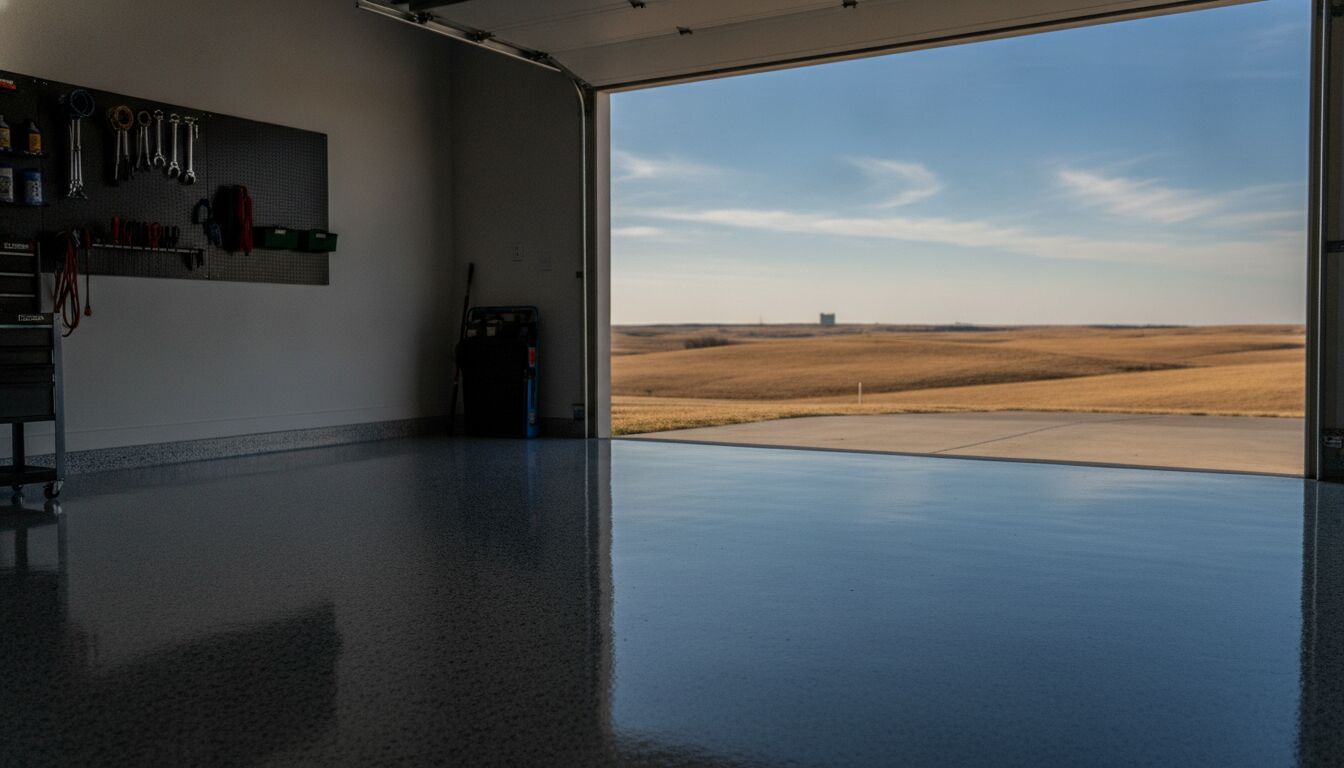
Most climate-driven coating advice talks about gradual wear — seasonal freezing, constant heat, persistent moisture. Oklahoma's real differentiator is different in kind: a sudden, concentrated impact event. Here's why that changes what "weather-resistant" should actually mean for a garage floor here.
Oklahoma regularly ranks among the top states nationally for hail-damaged properties. Hail isn't a slow process — small hail falls at roughly 9–25 mph, severe-storm hail (quarter-size and up) at roughly 25–40 mph, and the largest stones from the strongest supercells can exceed 70–100 mph. That's a sudden, high-energy point-load impact, not a gradual cycle.
Freeze-thaw cracking happens over many seasonal cycles as water expands in pores. Persistent-moisture damage builds up over continuous exposure. A hailstrike is neither — it's a discrete event that transfers kinetic energy to a single point, which can cause immediate localized fracture, spalling, or crazing in a rigid, brittle surface.
A hailstrike doesn't just chip a surface — the fracture it creates opens a new pathway for moisture to get in behind it, especially if wind-driven rain arrives during the same storm. That combination of acute impact damage followed by ongoing moisture intrusion is the real risk to an unprotected garage floor.
Polyurea's high elongation lets it absorb and distribute impact energy across a larger area instead of transmitting the full point-load stress directly into a brittle failure at the impact site. That's a different property than pure hardness or scratch-resistance — it's about surviving a sudden hit without cracking.
Want to know what a coating system built for Oklahoma's specific conditions looks like for your garage? Oklahoma Polyurea can walk you through it — reach out for a free estimate.
No obligation. We'll assess your space and give you a real number.